

 News
News Industry News
 With the rise of smart technology, point-infrared (PIR) sensors have become one of the key technologies for building smart homes, smart security and other fields due to their unique technological advantages and wide applications.
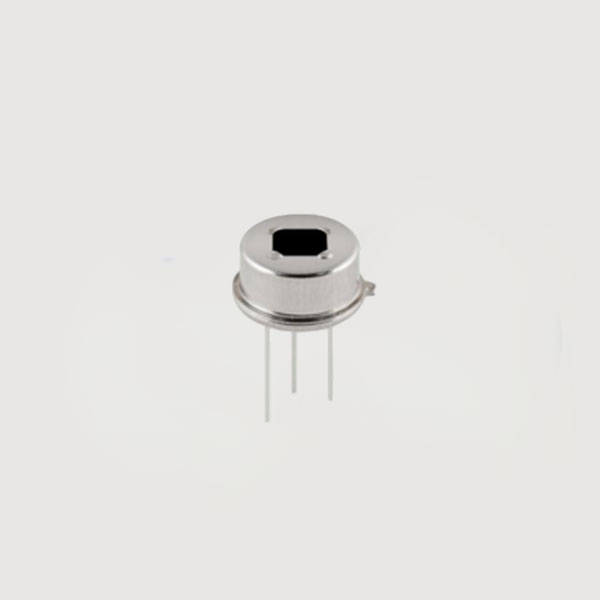
HDA-243A Pyroelectric infrared sensor
1.Principle: Sensing infrared radiation and capturing human activity.
A PIR (Passive Infrared) sensor is a non-contact device for detecting the presence of the human body. Its working principle is based on the pyroelectric effect, enabling it to capture changes in infrared radiation in the environment, especially the infrared radiation emitted by warm-blooded animals like humans.
The sensor typically contains a pyroelectric element. When a human enters the sensor's detection range, the temperature difference between the human and the surrounding environment causes a change in the infrared radiation field, resulting in a weak electrical signal change in the pyroelectric element. This signal is then amplified and analyzed by a signal processor. Once the change exceeds a preset threshold, human activity is detected, triggering corresponding control actions.
2.Features: Sensitive, accurate, and fast response.

High Sensitivity: Pyroelectric infrared sensors are highly sensitive to thermal radiation, enabling them to detect target objects even at very low temperature differences, thus achieving high-precision human body sensing and monitoring.
High Accuracy: Because pyroelectric infrared sensors can sense the infrared radiation emitted by target objects and convert it into electrical signals for analysis, they possess high accuracy. The sensor determines the presence of an object by measuring its temperature change, filtering out interference signals and reducing false alarms.
Fast Response: Pyroelectric infrared sensors have a very short response time, typically within milliseconds. Once a target object passes by, the sensor can immediately respond and trigger relevant applications or alarm systems.
Versatility: Pyroelectric infrared sensors can be customized and designed to meet various needs, enabling a variety of applications. For example, they can be used in indoor security monitoring systems, human body sensing lighting control systems, and smart home devices.
3.Applications: Ubiquitous, from homes to cities.
Smart Home: PIR sensors are thriving in smart homes, from automatic lighting systems (lights turn on when someone enters, turn off when they leave) to smart security alarms, and even automatic control of smart curtains and air conditioners, bringing users a convenient and energy-efficient living experience.
Smart Security: In commercial and residential security, PIR sensors are combined with surveillance cameras and alarm systems to form intelligent monitoring networks, effectively preventing intrusions and theft and improving security.
Health Monitoring: In the medical and elderly care fields, PIR sensors are also used for non-invasive patient activity monitoring, helping medical staff respond promptly to patients' needs while maintaining their safety.
Smart Cities: The application of PIR sensors in smart lighting, people flow statistics, and public safety monitoring provides data support for efficient urban management and resource optimization, promoting the development of smart cities.
In short, infrared human body sensors, with their unique technical characteristics and broad application potential, are constantly expanding the boundaries of smart technology, becoming a bridge connecting people and things and improving the quality of life. With the continuous advancement of technology and the deepening of innovative applications, infrared human body sensing sensors will demonstrate their indispensable value in more fields, leading a new trend in the intelligent era!
Email: [email protected]
WhatsApp: +86 18335818384
 Message
 E-mail
 Whatsapp


