

 News
News Industry News
 In the complex landscape of industrial production, hydrogen sulfide (H₂S) gas lurks as a silent and lethal threat. Highly toxic and corrosive, even a minor leak of H₂S beyond safe concentration limits can pose severe risks to the lives and health of on-site workers. It may also trigger equipment corrosion, production halts, and other major safety incidents, inflicting incalculable economic losses and reputational damage on enterprises. Therefore, selecting a precise and reliable H₂S gas detection device is paramount to ensuring safe production in the industrial sector. The Tensensor's MQ-E3-H2S sensor stands out as an ideal choice for industrial safety protection, thanks to its outstanding performance and wide adaptability.
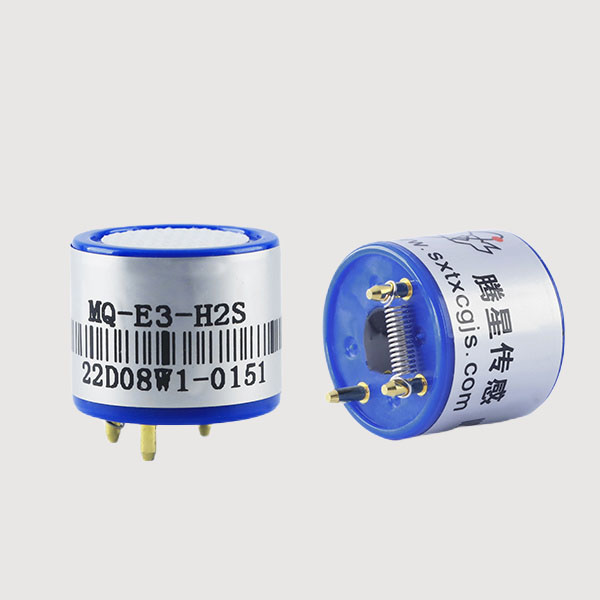
MQ-E3-H2S Electrochemical H2S Sensor

The MQ-E3-H2S adopts a potentiostatic electrolysis technology. H₂S and oxygen undergo corresponding redox reactions at the working electrode and counter electrode, releasing electric charges to form a current. The magnitude of the current is directly proportional to the H₂S concentration, enabling accurate determination of gas concentration by measuring the current. For industrial environments where precision is non-negotiable, this sensor delivers exceptional performance: it boasts a sensitivity of (0.8 ± 0.15) µA/ppm and a resolution as low as 0.1 ppm, allowing it to detect even the slightest changes in gas concentration and alert users to minor leaks promptly. With a wide linear measurement range (0 ~ 100 ppm) and an extended maximum measurement limit of 500 ppm, it meets the detection needs of various concentration intervals in industrial production, from routine inspections to emergency monitoring.
Industrial working environments are often characterized by drastic fluctuations in temperature and humidity, as well as cross-interference from multiple gases, posing strict challenges to sensor adaptability. The MQ-E3-H2S Sensor excels in environmental resilience, operating reliably within a temperature range of -20℃ ~ 50℃ and a humidity range of 15% ~ 90% RH. Whether in high-temperature and high-humidity chemical plants or low-temperature outdoor mining areas, it maintains stable performance. Its zero drift is ≤ 0.2 ppm within -20℃ ~ 40℃, and the monthly stability error is less than 2%, ensuring long-term detection accuracy and reducing the labor and time costs associated with frequent calibrations. In terms of anti-interference capability, the sensor performs remarkably well. It exhibits minimal response to common interfering gases in industrial settings: for example, the response to 200 ppm carbon monoxide is < 0.5 ppm, and to 1000 ppm alcohol is < 0.3 ppm. This effectively prevents false alarms, enabling workers to make accurate judgments about actual safety conditions.
Low power consumption is another key advantage of the MQ-E3-H2S Sensor. Industrial gas detection devices often require continuous long-term operation, and some rely on battery power. The sensor’s low-power design ensures longer battery life and lower operating costs while maintaining high performance, when paired with the recommended 10 Ω load resistor. It also features a fast response time (T90 < 30 seconds), quickly capturing concentration changes and transmitting signals at the moment of gas leakage, thus gaining valuable time for emergency response. With a repeatability error of less than 2% of the output value, it guarantees consistent detection results, providing reliable support for safety decision-making.
The MQ-E3-H2S Sensor is designed for ease of installation and use. It comes with clear references for basic circuits and test circuits, facilitating quick integration into existing enterprise safety monitoring systems. Detailed installation and usage precautions are also provided, such as prohibiting soldering during installation, avoiding pin bending, and requiring a pre-use aging period of no less than 48 hours, offering clear guidance for on-site construction and later maintenance. With a service life of 2 years (in air), it offers higher cost-effectiveness compared to similar products, reducing equipment replacement frequency and long-term enterprise investment.
The MQ-E3-H2S Sensor is widely applicable to various high-risk areas in the industrial sector. In the petrochemical industry, it can be used for H₂S leakage detection in drilling platforms, refineries, chemical reactors, and other equipment, preventing poisoning, explosions, and other accidents caused by gas leakage during production. In coal mining, it real-time monitors H₂S concentration in underground working environments, safeguarding the lives of miners. In environmental protection, it is suitable for sewage treatment plants, landfills, and other sites prone to H₂S generation, helping enterprises achieve compliant emissions and avoid environmental pollution and safety risks. Additionally, it plays a crucial safety role in metallurgy, pharmaceuticals, food processing, and other industries involving the production or use of H₂S.
Safety is the lifeline of industrial production. Choosing a high-quality H₂S gas sensor is a key measure for enterprises to fulfill their safe production responsibilities, protect employee rights and interests, and maintain stable production. The MQ-E3-H2S H₂S Sensor, with its core advantages of low power consumption, high precision, strong anti-interference capability, and excellent stability, perfectly adapts to the complex working conditions and strict requirements of the industrial sector. Backed by professional R&D strength and reliable product quality, Tensensor is committed to safeguarding industrial safety. Choose the MQ-E3-H2S H₂S Sensor to ensure accurate monitoring for every production operation, eliminate potential safety hazards, and lay a solid foundation for the sustainable and healthy development of your enterprise.
For inquiries, please contact:
Web: www.tensensor.com
Email: [email protected]
WhatsApp: +86 18335818384
 Message
 E-mail
 Whatsapp


